How to Keep a Trading Journal (Free Template Included)
Most traders who stop improving aren't short on information. They're short on memory. A losing trade feels vivid for an hour, then fades, and a week later the same setup, the same impulse and the same exit produce the same result.
A trading journal fixes that. It turns each trade into a small, written record you can come back to, compare and count. Over time those records answer questions your gut can't: which setups actually work for you, when you break your own rules, and what that costs.
This guide covers what to write in a trading journal, gives you a free template you can copy today, and shows a simple weekly routine for reviewing it. At the end, we'll show how Volume builds the same habit into practice sessions.
Why Journaling Separates Improving Traders from Everyone Else
Every trader makes mistakes. The difference is whether the mistakes get noticed, named and reduced, or quietly repeated.
Without a journal, your sense of your own trading is shaped by recency and emotion. A big win last Tuesday makes a setup feel reliable. A painful loss makes a perfectly good setup feel cursed. Neither impression is evidence.
With a journal, you have a dataset. Twenty entries won't prove anything, but they start to show tendencies. Fifty or a hundred entries, tagged consistently, let you compare one setup against another, or your disciplined trades against your impulsive ones. That's the point where journaling stops being homework and starts being useful.
Journaling also changes how you trade in the moment. If you know you'll have to write down your thesis and your stop, you're far more likely to have both before you click.
The 8 Fields That Matter
You can record dozens of things about a trade. Most of them won't change your decisions. These eight will.
- Setup or strategy tag. A short, consistent name for the kind of trade it was, such as "Breakout" or "Pullback to support". This is the single most important field, because it's what lets you group trades later.
- Thesis. One or two sentences on why you took the trade. If you can't write it, you probably didn't have one.
- Entry. The price you got in at, and ideally what triggered it.
- Stop. Where you planned to exit if you were wrong. Writing it down before the trade is what makes it a plan instead of a hope.
- Target. Where you planned to take profit. Together with entry and stop, this gives you your planned reward-to-risk.
- Size. How much of your account was on the line. Size mistakes often do more damage than entry mistakes.
- Emotion before. How you felt going in: calm, bored, rushed, chasing a move, trying to win back a loss. One word is enough.
- Review after. What happened, whether you followed your plan, and one thing you'd repeat or change.
Here's what each field is really asking:
| Field | The question it answers |
|---|---|
| Setup / strategy tag | Which of my setups actually make money? |
| Thesis | Did I have a reason, or was I reacting? |
| Entry | Am I entering where my plan says, or chasing? |
| Stop | Do I define risk before I enter, and do I respect it? |
| Target | Is the reward worth the risk I'm taking? |
| Size | Am I sizing consistently, or betting bigger when I feel sure? |
| Emotion before | Which emotional states lead to my worst trades? |
| Review after | What will I do differently next time? |
Free Trading Journal Template
Copy this into any notes app, spreadsheet or document. Fill in the top half before you enter the trade and the bottom half after you exit.
## Trade #___ | Date: ________ | Market / Symbol: ________

### Before the trade

- Setup / strategy tag:
- Thesis (1–2 sentences):
- Direction: Long / Short
- Planned entry:
- Stop:
- Target:
- Planned reward-to-risk: ___ : 1
- Size (% of account):
- Emotion before (one word):

### After the trade

- Actual entry:
- Actual exit:
- Result ($ and %):
- Exit reason: Stop / Target / Manual / Time
- Followed the plan? Yes / No (if no, where did I deviate?)
- What went right:
- What I'd change:
- Screenshot / chart link:
Keep the setup tags from a short, fixed list. "Breakout" and "breakout trade" and "BO" will look like three different strategies when you try to compare them.
A Weekly Review Routine (3 Questions)
Journaling without review is just record keeping. Once a week, set aside 20 minutes, read through every entry from that week and answer three questions.
- Which setup performed best, and which performed worst? Group the week's trades by strategy tag. Look at the win rate and, more importantly, the average win compared with the average loss. Our guide to profit factor, expectancy and win rate explains why a low win rate isn't automatically a problem.
- Where did I break my own plan? Find every trade where you moved a stop, skipped a stop, sized up or entered without a thesis. Note what those trades had in common, especially the emotion you recorded beforehand.
- What's one rule I'll focus on next week? Not five. One. "No trades within 10 minutes of a loss" or "Only take breakouts with a written stop" is enough to work on.
Write your answers at the top of next week's journal so you see them every time you trade.
Common Journaling Mistakes
Journaling only the losers. It's natural to dissect a painful loss and celebrate a win without a second look. But if only losses get recorded, your journal can't tell you what your winning trades have in common, and your stats will be skewed. Log every trade, including the boring ones.
No tags, so nothing is queryable. Free-text notes feel thorough, but you can't filter "felt rushed, kind of a breakout?" across 100 trades. Consistent tags for strategy and emotion are what turn a diary into data.
Writing the review days later. By then you've rationalized the trade. Write the review while the details are fresh, ideally right after you close.
Recording too much. A 30-field template is impressive for about three days. A short template you actually fill in beats a perfect one you abandon.
Never reading it back. If you haven't reviewed your journal in a month, it isn't helping. The weekly review is where the value comes from.
How Volume Builds Journaling into Practice
Volume replays real historical market data with time acceleration, using a virtual balance you choose (anywhere from $100 to $50,000). No real trades are executed, which makes it a low-stakes place to build the journaling habit before it has to compete with anything else.
The journal is built into the trading flow, so the factual half of the template is filled in for you. The thesis, emotion and review are still yours to write:
- Post-close prompt. When you close a position, a popup offers to create a journal entry for that trade, while the details are still fresh.
- Pre-filled trade details. Symbol, direction, entry, exit, cost, position size, P/L and duration come from the trade itself, so you don't have to type them.
- Strategy tags. Pick a saved trading strategy and trade type, along with the indicators and entry confirmations you used. Reusable presets keep your tags consistent.
- Risk fields. Record the stop loss, take profit and reward ratio you planned.
- Trade attributes. Toggle tags like Disciplined, Patient, FOMO or Revenge Trading to capture the emotion field honestly.
- Screenshots. Capture the current chart and attach it to the entry.
For a full walkthrough of the journal form and its options, see How to Journal with Volume.
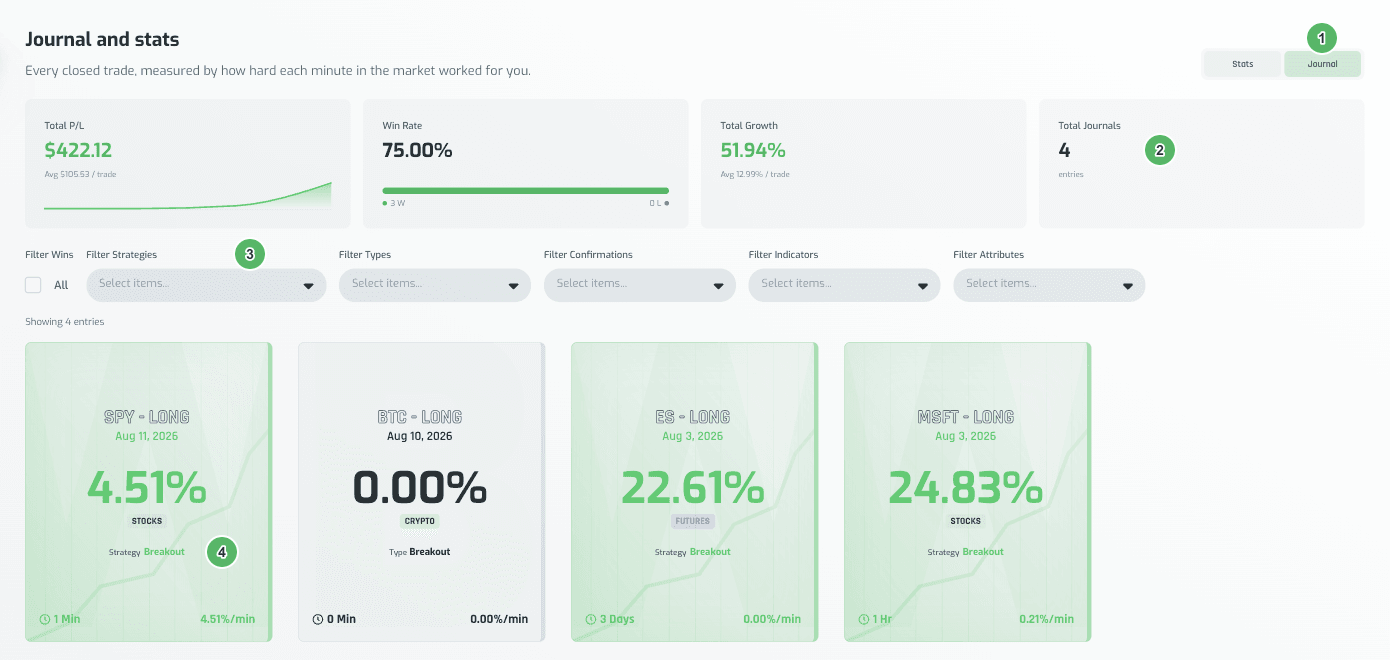
What you're seeing:
- Journal tab. Switch between Stats and your saved journal entries.
- Summary cards. Total P/L, win rate, total growth and entry count, recalculated for whatever entries are currently visible.
- Filter Strategies. Narrow the list to one or more strategy tags. Type, confirmation, indicator and attribute filters sit alongside it.
- Strategy on each entry. Every card shows the strategy you tagged, so your weekly review can start from the list.
Reviewing results by strategy
The weekly question "which setup performed best?" is answered on the Stats tab. Alongside breakdowns by direction, market, entry time, weekday, hold time, position size and exit method, the Strategy breakdown groups your journaled trades by the strategy you tagged.
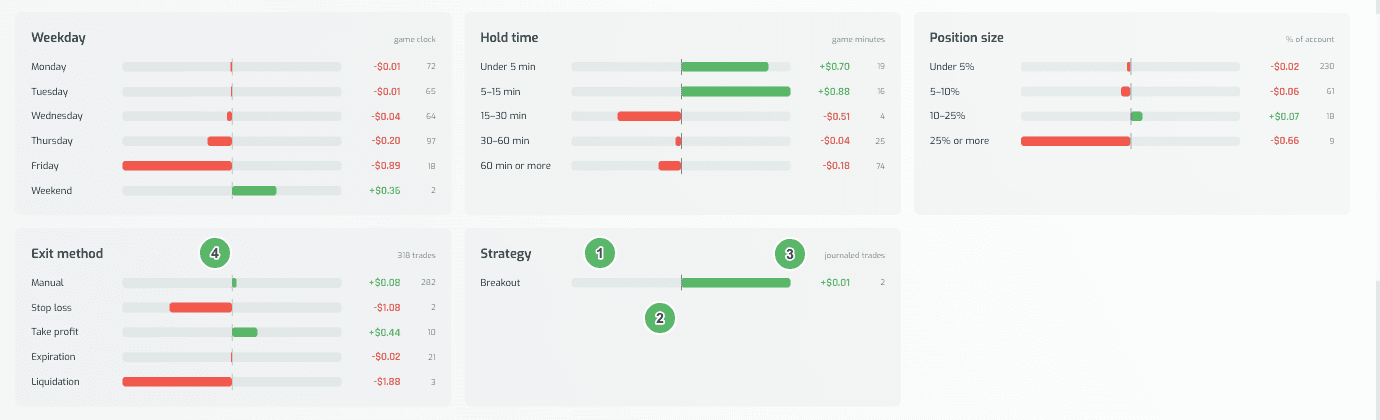
What you're seeing:
- Strategy breakdown. One row per strategy you've tagged in your journal entries.
- Result bar. Bars to the right of the center line made money and bars to the left lost it. The number of trades is shown at the end of the row.
- Journaled trades only. This card only counts trades with a journal entry, which is one more reason to journal every trade, not just the losers.
- Other breakdowns. Cards like Exit method cover every closed trade, so you can spot patterns across all your trades, journaled or not.
If you're new to Volume, start with How to Make Your First Trade, then journal it.
Your Trading Journal Checklist
- Pick a short, fixed list of strategy tags and stick to it
- Write your thesis, stop and target before you enter
- Record your size and one word for how you feel going in
- Journal every trade, winners and losers alike
- Write the review right after you close, not days later
- Attach a chart screenshot when you can
- Spend 20 minutes each week answering the three review questions
- Choose one rule to focus on for the next week
Start Your Journal Today
The best trading journal is the one you actually keep. Copy the template, tag every trade, and review once a week. The patterns will come.
If you'd like the journal to fill itself in while you practice on real historical data, open your Volume journal and log your next trade.