Why Most Traders Lose Money: The 1% Risk Rule Explained
Why do most traders lose money? Studies of retail day traders consistently show that somewhere between 70% and 90% of them lose money over time. The exact figure depends on the market, the time period and how "losing" is measured, but the range has held up across years of research and broker disclosures.
That statistic sounds like a verdict on skill, as if most people simply can't read a chart. It mostly isn't. When you look at how accounts actually blow up, the cause is rarely bad entries. It's bad sizing. A trader with mediocre entries and disciplined risk can stay in the game for years. A trader with good entries and no risk control can be gone in a week.
This guide covers the three habits behind most losses, the 1% rule that counters them, the position-sizing formula you need to apply it, and how to practice all of it in Volume until it's automatic.
Why Do Most Day Traders Lose Money?
Losing trades are normal. Even consistently profitable traders lose on a large share of their trades. What separates a bad week from a destroyed account is almost always one of three behaviors.
1. Oversizing
A trader puts 30%, 50% or all of their account into a single position because the setup "looks certain." When it works, it feels like genius. When it doesn't, one trade erases a month of progress. Oversizing turns ordinary bad luck into a crisis, because the account can't absorb a normal losing streak.
2. Trading without a stop
Without a predefined exit, there's no answer to the question "how much am I willing to lose on this?" The answer becomes "whatever happens," and that's how a small loss quietly becomes a large one while you wait for price to come back.
3. Moving the stop
This is the sneakiest of the three. The trader sets a stop, price approaches it, and they nudge it further away "to give the trade room." Each move feels reasonable. Together, they turn a planned $100 loss into an unplanned $600 loss. A stop that moves isn't a stop; it's a suggestion.
All three come from the same root: the size of the loss is decided by emotion in the moment instead of by a rule set in advance. The 1% rule is that rule.
What Is the 1% Rule in Trading?
The 1% rule says: never risk more than 1% of your account on a single trade.
Note the word risk. The rule does not say "only buy 1% of your account's worth of stock." It says the amount you would lose if your stop loss is hit should be no more than 1% of your balance.
On a $10,000 account, that means the most any one trade can cost you is $100. You can still hold a position worth thousands of dollars, as long as your stop is placed so that hitting it costs $100 or less.
Why 1%? Because it makes losing streaks survivable. Every trader hits them. Here's what ten losses in a row do to an account at different risk levels:
| Risk per trade | Account after 10 straight losses |
|---|---|
| 1% | about 90% of starting balance (down ~10%) |
| 2% | about 82% (down ~18%) |
| 5% | about 60% (down ~40%) |
| 10% | about 35% (down ~65%) |
At 1%, a brutal streak is an annoyance. At 10%, it's very hard to come back from, for reasons the drawdown section below makes clear. Some traders use 0.5% or 2% depending on their style and account, but 1% is the standard starting point for beginners for good reason.
How Much to Risk per Trade: The Position-Sizing Formula
Once you know how much you are willing to risk, position size stops being a guess. It becomes arithmetic:
Risk per trade   = Account balance × Risk %
Distance to stop = Entry price − Stop price   (use the absolute value for shorts)
Position size    = Risk per trade ÷ Distance to stop   (in shares or units)
Position value   = Position size × Entry price
The order matters. You pick your stop first, based on the chart: below a support level, beyond a recent swing, wherever the trade idea is clearly wrong if price gets there. Then the formula tells you how big the position can be. You never move the stop to fit a position size you wanted in advance.
Three Worked Examples on a $10,000 Virtual Account
All three trades risk the same $100 (1% of $10,000). Only the distance to the stop changes.
| Example | Entry | Stop | Distance to stop | Shares (=$100 ÷ distance) | Position value | Max loss |
|---|---|---|---|---|---|---|
| A: wide stop | $50.00 | $48.00 | $2.00 | 50 | $2,500 | $100 |
| B: medium stop | $200.00 | $197.00 | $3.00 | 33 | $6,600 | $99 |
| C: tight stop | $25.00 | $24.75 | $0.25 | 400 | $10,000 | $100 |
A few things stand out:
- Same risk, very different position sizes. Example A uses a quarter of the account, Example C uses all of it. The dollar risk is identical.
- Round down, never up. In Example B, $100 ÷ $3 is 33.3 shares. Rounding down to 33 keeps the loss under your limit.
- Tight stops create big positions. Example C would need the entire account. If the formula asks for more than you have, the trade either needs a smaller position (and less than 1% risk) or it isn't the right trade. Reaching for leverage to make the number fit is how oversizing sneaks back in. If you want to understand that tradeoff properly, read How to Trade with Leverage first.
Notice that nothing in the formula depends on how confident you feel. That's the point.
The Drawdown Math: Why a 50% Loss Needs a 100% Gain
A drawdown is how far your account has fallen from its peak. The reason big drawdowns are so dangerous is that recovery is not symmetrical. If you lose 50%, your $10,000 account is now $5,000. Getting back to $10,000 requires doubling what's left, a 100% gain.
| Drawdown | Balance (from $10,000) | Gain needed to recover |
|---|---|---|
| 10% | $9,000 | 11.1% |
| 20% | $8,000 | 25% |
| 30% | $7,000 | 42.9% |
| 50% | $5,000 | 100% |
| 75% | $2,500 | 300% |
| 90% | $1,000 | 900% |
Small drawdowns are cheap to recover from. Large ones get disproportionately harder. This is the real reason the statistics look the way they do: traders who oversize eventually take a deep drawdown, and from there the math is working against them. The 1% rule keeps you in the top rows of this table, where recovery is realistic.
How to Practice the 1% Rule in Volume
Knowing the rule takes five minutes. Following it when a trade goes against you takes practice. Volume replays real historical market data with time acceleration, so you can run through dozens of trades in a session and build the habit without any real money involved. Your balance is virtual, and you choose it.
Step 1: Pick an Account Size You Can Do the Math On
When you create a paper account from the dashboard, you set the starting balance anywhere from $100 to $50,000. A $10,000 balance makes 1% an easy $100, which is why the examples above use it.
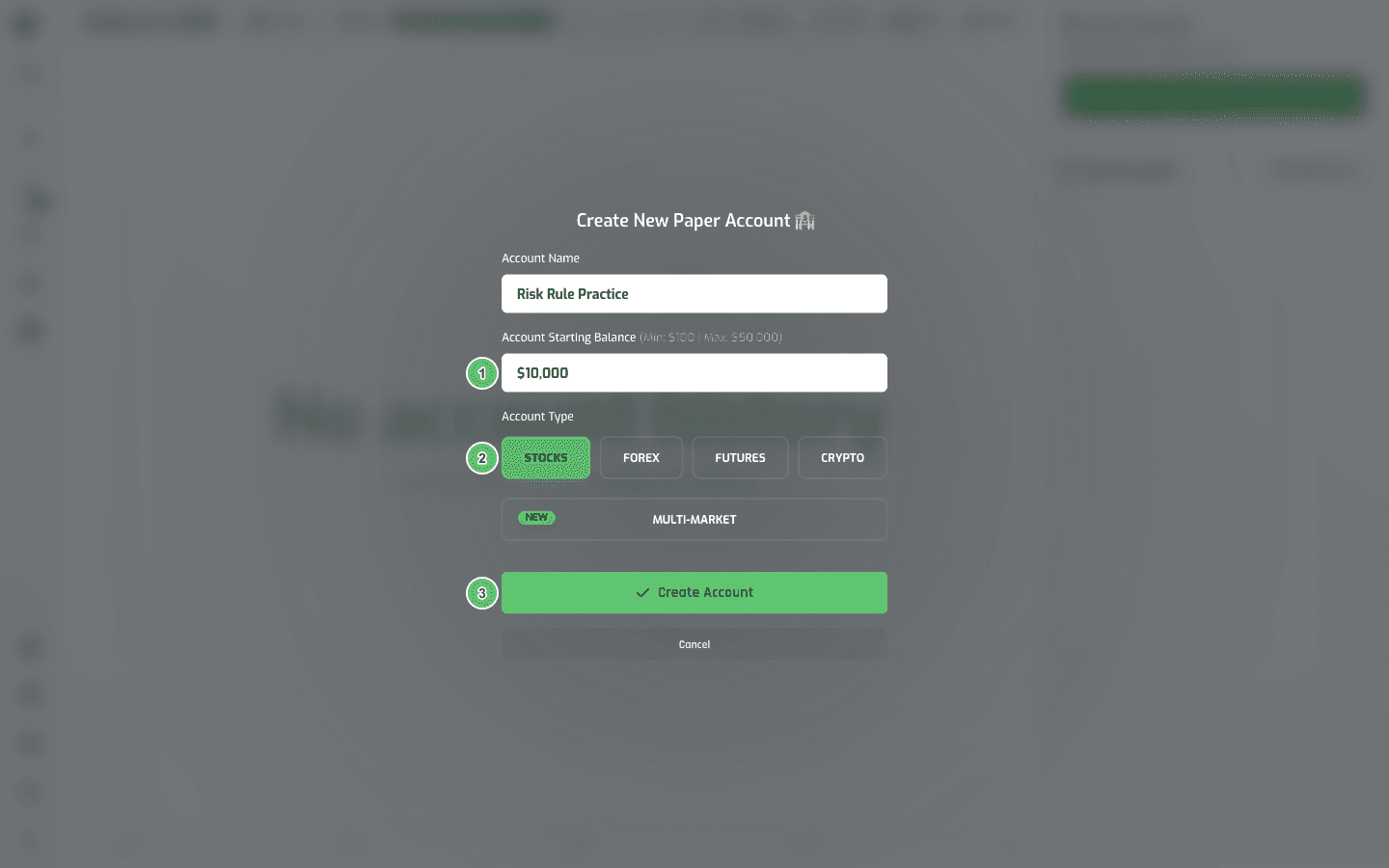
What you're seeing:
- Account Starting Balance: any amount from $100 to $50,000. Pick one and write down your 1% figure.
- Account Type: the market this account trades. Stocks is a good place to start practicing sizing.
- Create Account: creates the account so you can start a game on it.
Step 2: Set Your Stop, Then Size the Position in the Ticket
Open a trade ticket in the gameroom during market hours. The amount field and slider control how much of your cash goes into the trade. Under Leverage & Limit Options, clicking Add next to Stop Loss seeds a default stop about 0.2% from the live price, which you can then adjust to the level your chart analysis gives you.
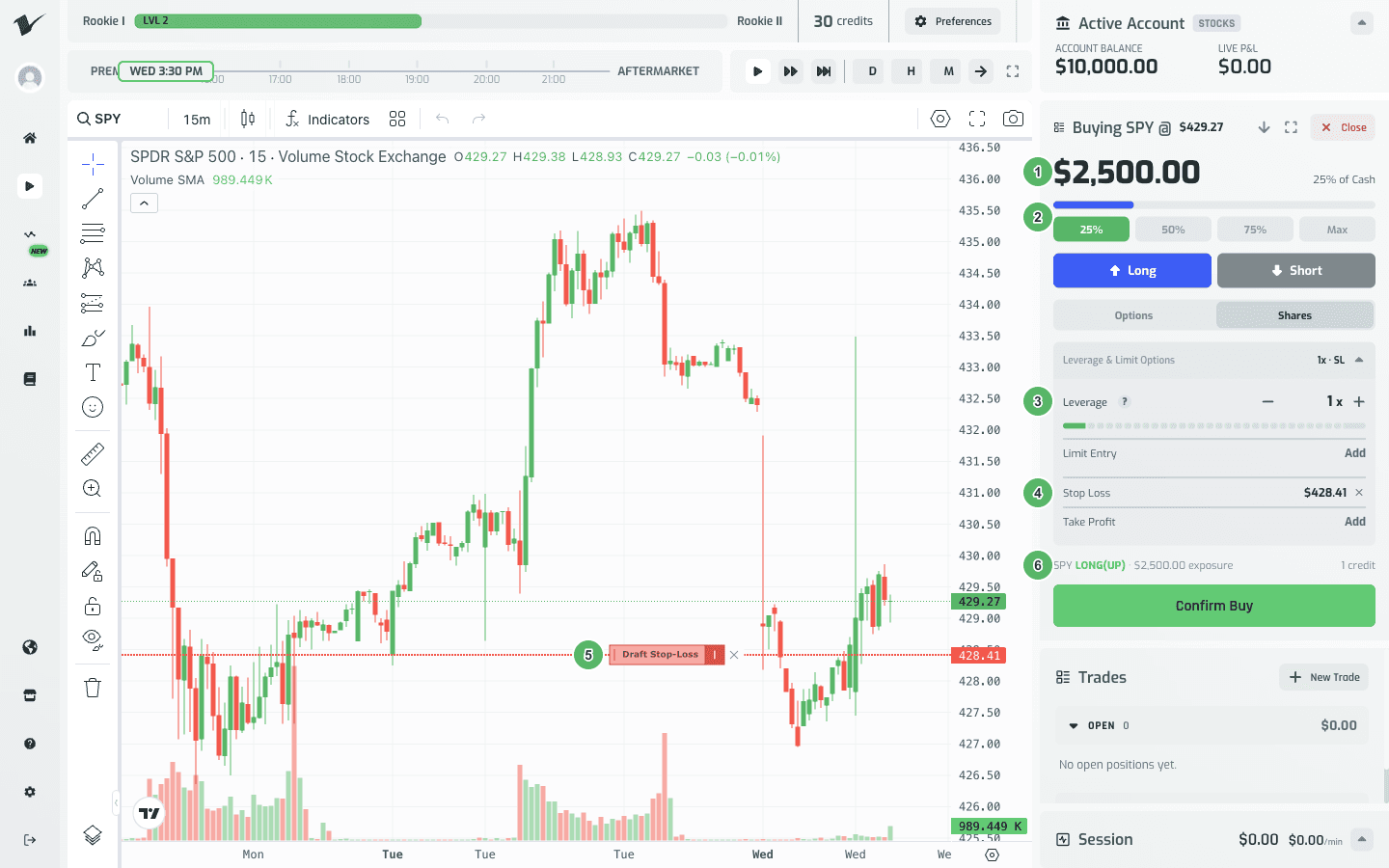
What you're seeing:
- Amount: the dollar value of the position, with the percent of your cash it uses on the right
- Amount slider and presets: drag the slider or tap 25%, 50%, 75% or Max
- Leverage: leave this at 1x while you're learning to size
- Stop Loss: the seeded default stop, editable to your own level
- Draft Stop-Loss line: your stop drawn on the chart, so you can check it sits beyond a meaningful level
- Exposure summary: direction and total exposure before you confirm
Now run the formula. In the screenshot, $2,500 buys about 5.8 shares at $429.27, and the stop is $0.86 below entry, so this trade risks roughly $5, a twentieth of a 1% budget. To risk the full $100 with a stop that tight, you'd need a position of about $50,000, far more than the account holds. That's Example C from the table in real life: either widen the stop to a level the chart justifies and recalculate, or accept risking less than 1%. Both are fine. What isn't fine is deciding the size first and then picking a stop to match.
If the P&L math behind this feels fuzzy, How Volume Calculates Position P&L walks through it, and How to Make Your First Trade covers the ticket from the beginning.
Step 3: Check Your Stats Tab
After a few sessions, open Journal and Stats and look at the Stats tab. Two places tell you whether the rule is working:
- Avg win / avg loss: your average loss should sit close to your 1% figure. If it's consistently larger, stops are being moved or skipped.
- Runup vs drawdown chart: each trade's best and worst point while open. Losers that went far past where your stop should have been are the "moved stop" habit showing up in data.
The position-size breakdown further down the page also shows whether your biggest positions are where your biggest losses come from. For what each number on the Stats tab means, see Profit Factor, Expectancy and Win Rate Explained.
The 1% Rule Checklist
Before every trade:
- I know my account balance and my 1% figure in dollars.
- I chose my stop from the chart, not from how much I wanted to buy.
- I calculated position size as risk ÷ distance to stop, and rounded down.
- The position fits in my account without reaching for extra leverage.
- The stop is entered in the ticket before I click Confirm.
After every trade:
- I did not move the stop further away while the trade was open.
- If I lost, the loss was close to my planned amount.
- I noted anything that tempted me to break the rule.
Practice the Rule Until It's Boring
The traders in that 70–90% statistic usually knew they should use stops and size small. What they hadn't done was practice it enough that it held up under pressure. That's a skill, and skills come from repetition.
Open the gameroom, pick a balance, write down your 1% number, and size your next ten trades with the formula. No real money is at stake, so the only thing on the line is the habit itself.