Paper Trading vs Backtesting: Which Should You Do First?
If you have spent any time reading about trading, you have seen two pieces of advice repeated everywhere: "backtest your strategy" and "paper trade before you do anything else." Both are good advice. They are also not the same thing, and doing them in the wrong order can waste weeks or hand you confidence you have not earned.
This guide breaks down the difference between paper trading and backtesting, what each method can and cannot tell you, and a practical sequence for a new trader. At the end, we will show how Volume lets you get the strengths of both in the same session.
What Is Backtesting?
Backtesting means applying a set of trading rules to historical price data to see how those rules would have performed. You define the entry, the exit, the stop, and the position size, then walk through past charts (by hand or with code) and record every trade the rules would have triggered.
The appeal is speed and sample size. A strategy that might trigger twice a week in real time can be tested across years of data in an afternoon. That gives you something no other method gives you quickly: a large number of trades to judge.
What backtesting proves: whether a clearly defined set of rules had a positive expectancy over a specific stretch of history, and roughly how deep its losing streaks got.
What backtesting hides:
- You already know what happened. Even when you try not to, you see the chart to the right of your entry. It is very hard to "unsee" the outcome.
- Your emotions are absent. A spreadsheet does not hesitate after four losses in a row. You might.
- Rules drift toward the data. The more you tweak a strategy to fit past charts, the better it looks on those charts and the less it tells you about anything else. This is called overfitting.
- Execution is assumed, not practiced. A backtest records that you entered at a price. It does not train you to actually press the button at that moment.
What Is Paper Trading?
Paper trading means placing simulated trades as the market unfolds, using a virtual balance instead of real money. You watch price develop bar by bar, decide in the moment, and live with the result until you close the position.
What paper trading proves: whether you can follow your rules when you do not know what comes next. It tests discipline, timing, patience, and the habit of setting a stop before you need one.
What paper trading hides:
- It is slow. If you paper trade in real time, a strategy that triggers twice a week needs months to produce a meaningful number of trades.
- Small samples mislead. Ten paper trades can look brilliant or terrible purely by chance. Many traders change strategies based on a handful of results.
- Market conditions are limited to "now." If you only practice in the current market, you only learn the current market. A strategy built in a quiet month may never have met a fast, trending one.
Paper Trading vs Backtesting at a Glance
| Backtesting | Paper trading | |
|---|---|---|
| Core question | Did these rules have an edge in the past? | Can I execute these rules without knowing the outcome? |
| Data | Historical | Unfolding bar by bar |
| Speed | Fast: years of data in hours | Slow in real time: weeks or months |
| Sample size | Large | Small unless you practice for a long time |
| Hindsight bias | High risk | Low risk |
| Emotional pressure | None | Some (you are making live decisions) |
| Main skill trained | Rule design and evaluation | Discipline and execution |
| Typical mistake | Overfitting rules to past charts | Judging a strategy on too few trades |
Neither column wins. They measure different things, and a strategy needs to pass both tests before you can say much about it.
Common Mistakes With Each
Backtesting mistakes
- Testing vague rules. "Buy when it looks strong" cannot be backtested. If you cannot write the rule down precisely, you are testing your mood, not a strategy.
- Peeking. Scrolling past your entry before recording the trade quietly inflates your results.
- Tuning until it works. Changing a moving average from 20 to 17 because 17 looked better on last year's chart is a warning sign, not a discovery.
- Ignoring the losing streak. The average result matters less than whether you could have sat through the worst run of losses.
Paper trading mistakes
- Trading without a plan. Paper trading only teaches you something if you decide your entry, stop, and target before you click.
- Oversizing because "it's not real." If you would never risk half your account on one idea, do not do it in practice either. Size every trade the way you intend to size it in your plan.
- Quitting a strategy after five trades. That is not enough evidence in either direction.
- Not writing anything down. Without a record of why you took each trade, you cannot tell a good decision with a bad outcome from a bad decision with a good one.
Which Should You Do First?
For most new traders, the answer is: a little paper trading first, then backtesting, then paper trading again.
That sounds backwards to some people, so here is the reasoning.
- Paper trade briefly to learn the mechanics. Before you can backtest anything meaningful, you need to know what an entry, a stop, and a position size actually feel like on a chart. A few practice sessions teach you the vocabulary. Our guide on how to make your first trade covers exactly this.
- Write down one simple rule set. One setup, one entry trigger, one stop rule, one exit rule, one sizing rule. Keep it boring.
- Backtest it for sample size. Run those rules across a wide range of historical charts. You are looking for two things: whether the expectancy is positive, and how bad the losing streaks get.
- Paper trade the same rules forward. Now you test the part a backtest cannot: whether you follow the rules when you do not know the outcome. Compare your paper results with the backtest. A large gap usually points to execution, not the strategy.
- Review, adjust one thing, repeat. Change one variable at a time, and only when you have enough trades to justify it.
The point is not to "graduate" from practice. Practice is the training. The goal is to build skill and self-knowledge you can measure.
How Volume Combines the Two
The traditional problem is a trade-off: backtesting gives you sample size without real decision-making, and paper trading gives you real decision-making with a painfully slow sample. Volume is built to close that gap.
Volume replays real historical market data bar by bar, so price unfolds in front of you the same way it would in a paper trading session. You cannot scroll ahead and see the outcome. But because it is history, you can compress time, which is what gives you backtest-style sample size. Every trade uses a virtual balance you choose when you create an account, anywhere from $100 to $50,000, and nothing is ever executed in a real market. For a full walkthrough, see how Volume trading works.
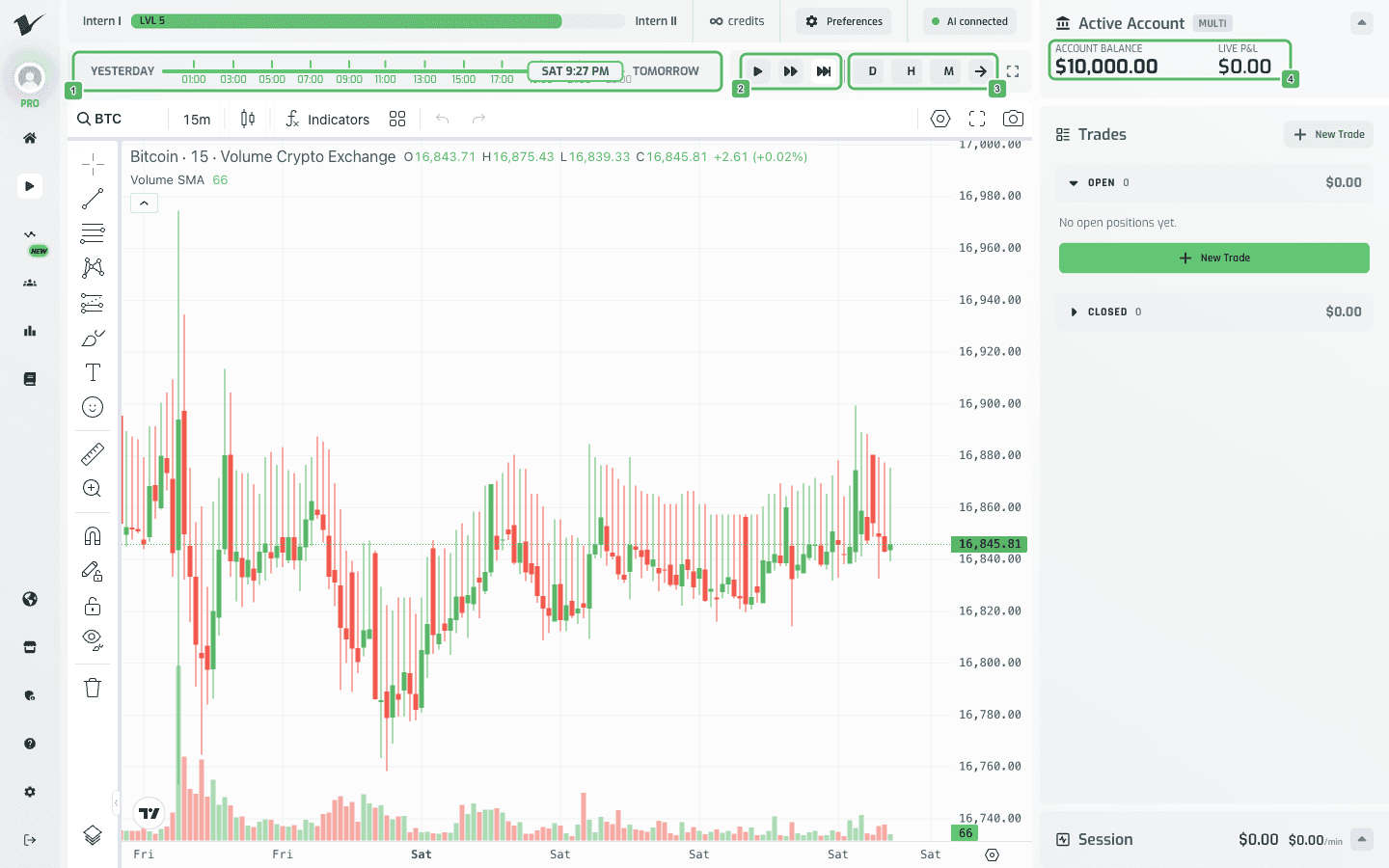
What you're seeing:
- Timeline bar: the current game time within the trading day. History plays forward from here, and you cannot see what comes next.
- Speed controls: play at normal speed, fast, or very fast. At the default very fast speed of 360x, an hour of market time passes in about ten seconds.
- Skip controls: jump forward by days (D), hours (H), or minutes (M) to get past quiet periods and reach the next setup.
- Active account: your virtual balance and live P&L for this practice account.
This is the "compress time" idea in practice. You can slow down to 1x when a setup is forming and you need to make a real decision, then speed up or skip through the stretches where your rules say to wait. A strategy that would take months to test forward in real time can collect dozens of decisions in a few sessions, without the hindsight that creeps in when you scroll back through old charts.
By default, Volume also drops you at a random point in market history, so you meet trending markets, choppy markets, quiet days, and volatile ones, not just whatever the market happens to be doing this month.
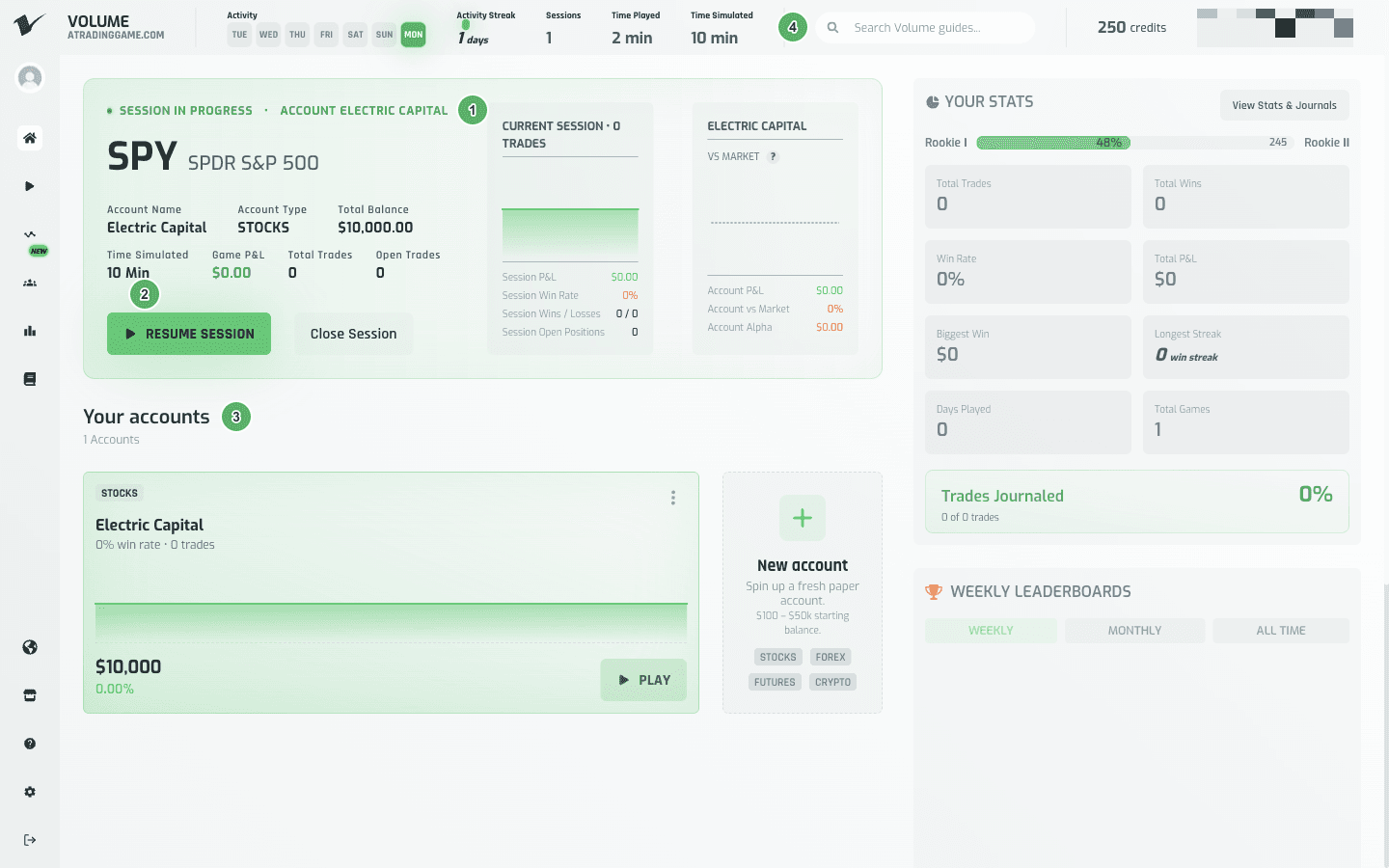
What you're seeing:
- Session in progress: your active game, with its account, balance, P&L, and trade counts. Resume it or close it from here.
- Time simulated: how much market time this session has covered. This is your sample, measured in market hours rather than clock hours.
- Your accounts: each practice account keeps its own balance, win rate, and trade history. A useful habit is one account per strategy, so the results for each rule set stay separate.
- Total time simulated: all the market time you have practiced across every session.
For a step-by-step method, read how to backtest a trading strategy manually. For an overview of each workflow, see backtesting with Volume and paper trading with Volume.
A Simple Decision List
Use this list to decide what to do in your next practice session:
- Never placed a trade with a stop and a target? Start with a few paper trades to learn the mechanics.
- Can't write your strategy as rules? Paper trade and journal until you can describe what you keep doing.
- Have written rules but fewer than about 30 recorded trades? Focus on sample size: compress time and collect more decisions.
- Backtest looks good but your own results don't match? Slow down and paper trade at 1x. The gap is usually execution.
- Results only work in one kind of market? Practice across more random sessions before drawing conclusions.
- Changed more than one rule since your last review? Roll back and change one thing at a time.
Start Practicing
Backtesting tells you whether a set of rules has held up on past data. Paper trading tells you whether you can follow them. You need both, and you do not have to choose between them.
Open the gameroom, pick a practice account, and run your rules through real market history at whatever speed the moment calls for.