What Is Leverage in Trading? 10x Explained With a Simulator
Leverage is one of the first words new traders run into, and one of the most misunderstood. Exchanges advertise "up to 100x" like it's a feature you'd be foolish to leave on the table. It isn't a feature. It's a multiplier, and it multiplies everything, including your mistakes.
This guide explains what leverage is in plain terms, works through the math with real numbers, separates leverage from margin, and shows how it fits with sensible risk rules. At the end, you'll see exactly how leverage works in Volume, a trading game that replays real historical market data on a virtual balance you choose ($100 to $50,000), so you can watch what 10x does to a position without any real money on the line.
What Is Leverage in Trading?
Leverage lets you control a position larger than the cash you put up. At 10x leverage, $100 of your money controls $1,000 of market exposure. When the market moves, your profit or loss is calculated on the $1,000, not the $100.
That's the whole idea. Leverage doesn't change the market, your entry, or your odds of being right. It changes how much each percent of price movement is worth to you.
Two numbers matter on every leveraged trade:
- Cost (or margin): the cash you commit to open the position.
- Exposure (or notional value): cost × leverage. This is the size the market actually "sees," and it's the number your P&L moves with.
Most beginner blowups come from watching the first number and forgetting the second.
Leverage Multiplies Gains and Losses Equally
Here's what happens to a $1,000 cost at different leverage levels when the market moves 1% or 5%. The move works the same in either direction: swap the plus signs for minus signs if the trade goes against you.
| Leverage | Exposure | 1% move | Return on cost | 5% move | Return on cost |
|---|---|---|---|---|---|
| 1x | $1,000 | ±$10 | ±1% | ±$50 | ±5% |
| 5x | $5,000 | ±$50 | ±5% | ±$250 | ±25% |
| 10x | $10,000 | ±$100 | ±10% | ±$500 | ±50% |
| 50x | $50,000 | ±$500 | ±50% | ±$2,500 | ±250% |
Read the bottom row twice. At 50x, an ordinary 5% move (crypto can do that before lunch) swings your P&L by two and a half times the cash you put in. At 10x, the same move erases half your stake. At 1x, it's a 5% bump you'd barely notice.
The table is symmetric because leverage is symmetric. Anyone who tells you leverage "boosts returns" is describing only half of the table.
Leverage vs. Margin
People use these words interchangeably, but they describe two sides of the same deal:
- Margin is the money you put down. It's a deposit, not a fee.
- Leverage is the ratio between your exposure and that deposit.
A 10% margin requirement and 10x leverage describe the same position: $1,000 of margin supports $10,000 of exposure. Brokers tend to talk in margin percentages; crypto exchanges tend to talk in multipliers.
In real markets, a broker also sets a maintenance margin, a minimum your deposit must stay above as the trade moves. Fall below it and you get a margin call (add more money) or a liquidation (the broker closes your position for you, usually at a bad price). The higher your leverage, the smaller the move that triggers it. At 50x, a move of around 2% against you can wipe out the deposit entirely.
Why "Cost" and "Exposure" Are Different Numbers
If you only remember one thing from this guide: your risk lives in the exposure, not the cost.
Say you open a $100 position at 10x. It feels like a $100 trade. It isn't. It's a $1,000 trade that you've paid $100 to open. If price drops 3%, you lose $30, which is 30% of what you put in.
This is why experienced traders size positions by exposure first and treat leverage as a detail of how they fund it. Two trades with the same exposure carry the same market risk whether you opened them as $1,000 at 1x or $100 at 10x.
Leverage and the 1% Rule
The 1% rule says you shouldn't lose more than about 1% of your account on any single trade. Leverage doesn't break that rule. Misusing it does.
The amount at risk on a trade is roughly:
Risk = exposure × distance to your stop loss
With a $10,000 account, 1% is $100. If your stop is 5% below your entry, the most exposure you can carry is $2,000 ($2,000 × 5% = $100). That's true at any leverage:
- At 1x, you'd commit $2,000 of cash.
- At 10x, you'd commit $200 of cash for the same $2,000 exposure.
The risk is identical. Leverage just let you tie up less cash. The healthy use of leverage is exactly this: a wide, logical stop with a small cost, not a bigger bet. The unhealthy use is keeping the $2,000 cost and cranking it to 10x, which turns a $100 risk into a $1,000 risk with one click.
How Leverage Works in Volume
Volume replays real historical market data with time acceleration. Nothing is ever executed for real and the balance is virtual, so it's a safe place to see leverage do its thing. Here's how it's set up, straight from the game's rules.
Default and caps
Every new trade ticket starts at 1x, meaning no leverage. You raise it yourself, up to each market's cap:
| Market | Leverage control | Maximum |
|---|---|---|
| Stocks (shares) | Yes | 20x |
| Stocks (options) | No, fixed | Implicit 10x |
| Futures | Yes | 20x |
| Forex | Yes | 50x |
| Crypto | Yes | 100x |
Stock options aren't leverage-selectable. Their payoff curve already behaves like roughly 10x, shaped by the expiration you pick, so the ticket shows an Expiration control instead. For the full formula, see How Volume Calculates Position P&L.
Reading cost vs. exposure on the ticket
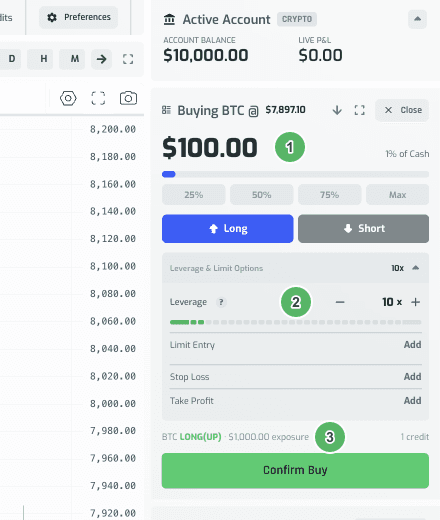
What you're seeing:
- Amount: the cost of the trade, $100, which is 1% of this $10,000 account's cash.
- Leverage meter: set to 10x. The bar fills and shifts from green toward red as leverage rises.
- Exposure line: $100 × 10 = $1,000 exposure. This is the number your P&L will move with.
Hitting the cap
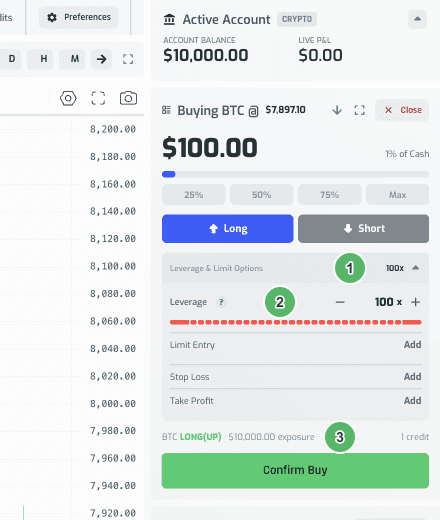
What you're seeing:
- Leverage summary: 100x, the crypto maximum. Typing a higher number snaps it back to the cap.
- Leverage meter: fully red. The color is a deliberate warning, not decoration.
- Exposure line: the same $100 now controls $10,000. A 1% move against you costs the full $100.
No liquidation, so your stop loss matters more
Volume does not liquidate leveraged positions, and there are no margin calls. That sounds forgiving, but it cuts the other way: a leveraged position that keeps losing stays open, its value can go below zero, and closing it debits more than the cost you put in. If your account balance hits zero, the game ends in a Game Over.
The one exception is stock options, where the maximum loss is capped at your entry cost by the options payoff model.
In practice, nothing in the game will cut a losing leveraged trade for you. Only a stop loss you set, or closing the trade yourself, ends it. For a walkthrough of every leverage control on the ticket, including the position badge and closing a leveraged trade, see How to Trade with Leverage in Volume.
Leverage Checklist
Before you confirm a leveraged trade, run through this:
- I know my exposure (cost × leverage), not just my cost.
- I've placed a stop loss at a level that makes sense on the chart.
- Exposure × stop distance is no more than about 1% of my account.
- I'm using leverage to reduce cost, not to increase risk.
- I've checked the leverage control, since every new ticket starts at 1x.
- I can explain what a 5% move against me would cost in dollars.
FAQ
What does 10x leverage mean?
It means your position is ten times the size of the cash you committed. $100 at 10x gives you $1,000 of exposure, so a 1% price move changes your P&L by $10, which is 10% of your $100.
Is higher leverage riskier?
Only if exposure goes up with it. The risk on a trade comes from exposure and stop distance. 10x on a $100 cost carries the same market risk as 1x on $1,000. The danger is that high leverage makes very large exposure feel cheap.
What is the difference between leverage and margin?
Margin is the cash deposit that opens the position. Leverage is the ratio of exposure to that deposit. A 10% margin requirement equals 10x leverage.
Can you lose more than you invest with leverage?
In some real markets, yes, depending on the product and how fast price moves past your liquidation level. In Volume, leveraged positions are never liquidated, so a losing position can lose more than its cost unless your stop loss closes it first. Stock options are the exception, with losses capped at entry cost.
Practice Leverage Where It Can't Hurt You
Leverage is easier to understand once you've watched a 10x position move in real time. In Volume, you can open a crypto, forex, futures, or stock-shares trade, set the meter to 2x, 10x, or the market's cap, and watch how the exposure line and your P&L react to real historical price action. The balance is virtual and the trades are never executed, so the only thing at stake is the lesson.
Open the gameroom and try the same trade at 1x and 10x with the same stop. Compare the results, then decide how much leverage your strategy actually needs.