Stock, Futures, Forex and Crypto Market Hours Explained (ET, With Daily Breaks)
"The market" is not one thing with one set of hours. US stocks keep office hours. Equity index futures trade almost around the clock but stop for an hour every afternoon. Forex runs from Sunday evening to Friday evening without a nightly close. Crypto never stops at all.
If you trade more than one of these, or you are trying to figure out why your chart suddenly went flat at 5:00 PM, this market hours reference is for you. Every time below is in Eastern Time (ET), the time zone US exchanges use. Exchanges set their hours on New York's clock, so these times hold all year; daylight saving only changes how they convert to your own time zone.
At the end, we cover how Volume applies these same schedules when you practice on replayed historical data.
US Stock Market Hours
The New York Stock Exchange and Nasdaq share the same schedule.
| Session | Time (ET) | Days |
|---|---|---|
| Premarket | 4:00 AM - 9:30 AM | Monday - Friday |
| Regular trading hours | 9:30 AM - 4:00 PM | Monday - Friday |
| After-hours (aftermarket) | 4:00 PM - 8:00 PM | Monday - Friday |
Regular trading hours are what most people mean by "market hours." This is when the opening and closing auctions happen, when liquidity is deepest, and when official daily prices are set.
Premarket and after-hours are extended sessions. Trades do happen, but volume is thinner and spreads are usually wider, which is why big moves on earnings or overnight news often show up first in these windows. Many brokers only allow certain order types during extended hours.
Weekends and holidays: stocks do not trade on Saturday or Sunday, or on full exchange holidays such as Thanksgiving, Christmas, New Year's Day and Good Friday.
Early closes (half days): on a handful of days, regular trading ends at 1:00 PM ET instead of 4:00 PM. The usual ones are the day after Thanksgiving, Christmas Eve and July 3rd (when they fall on weekdays).
Futures Market Hours (CME Equity Index Futures)
When people search "futures market hours," they usually mean CME Globex equity index futures like the E-mini S&P 500 (ES) and E-mini Nasdaq-100 (NQ). Those trade nearly 24 hours a day, five days a week.
| Event | Time (ET) |
|---|---|
| Weekly open | Sunday 6:00 PM |
| Daily maintenance break | 5:00 PM - 6:00 PM, Monday - Thursday |
| Weekly close | Friday 5:00 PM |
So when does the futures market close? Twice, depending on what you mean. Monday through Thursday it pauses for one hour, from 5:00 PM to 6:00 PM ET. On Friday it closes at 5:00 PM ET and stays closed for the weekend until Sunday at 6:00 PM ET.
A detail that trips people up: the futures trading day does not line up with the calendar day. The session that opens at 6:00 PM on Sunday is Monday's session. The session that opens at 6:00 PM Monday is Tuesday's session, and so on. If you look at a daily candle on ES, it covers 6:00 PM the previous evening to 5:00 PM that day.
Holidays: futures handle holidays differently from stocks. On most US holidays (Martin Luther King Jr. Day, Presidents' Day, Memorial Day, Juneteenth, Independence Day, Labor Day, Thanksgiving), equity index futures still trade in the morning, then halt from about 1:00 PM to 6:00 PM ET before the next session opens. The same halt applies on stock-market half days. New Year's Day, Good Friday and Christmas are full closures, and the prior evening's session is cancelled too.
Other futures (agricultural, some energy and interest-rate contracts) have their own schedules, so check the exchange's contract specs for anything outside the equity index products.
Forex Trading Hours
The currency market has no central exchange. It trades through banks and dealers in Sydney, Tokyo, London and New York, so as one region's day ends, another's begins.
| Event | Time (ET) |
|---|---|
| Weekly open | Sunday 5:00 PM |
| Weekly close | Friday 5:00 PM |
From Sunday 5:00 PM ET to Friday 5:00 PM ET, forex trades continuously. There is no nightly break and no premarket or after-hours distinction. Saturday is closed.
Forex also ignores most US holidays. The pairs keep trading on Thanksgiving or Memorial Day, though activity is lighter. The practical exceptions are Christmas Day and New Year's Day, when the market is effectively shut.
Even with no closing bell, forex has a rhythm. Liquidity tends to peak when London and New York are both open (roughly 8:00 AM to noon ET), and it thins out in the hours after the New York afternoon.
Crypto Trading Hours
Crypto trades 24 hours a day, 7 days a week, 365 days a year. There is no open, no close, no weekend and no holiday schedule.
That does not mean every hour behaves the same. Volume often drops over weekends and overnight in the US, and weekend moves can look different from weekday moves. But there is never a moment when you cannot place an order on a major crypto exchange.
Market Hours Summary Table
| Market | Opens (ET) | Closes (ET) | Daily break | Weekends | US holidays |
|---|---|---|---|---|---|
| US stocks (regular) | 9:30 AM, Mon - Fri | 4:00 PM (1:00 PM half days) | 4:00 PM - 9:30 AM | Closed | Closed |
| US stocks (extended) | 4:00 AM premarket | 8:00 PM after-hours | 8:00 PM - 4:00 AM | Closed | Closed |
| Equity index futures | Sunday 6:00 PM | Friday 5:00 PM | 5:00 PM - 6:00 PM | Closed Fri 5 PM - Sun 6 PM | Most: halt 1:00 - 6:00 PM. Full close: New Year's, Good Friday, Christmas |
| Forex | Sunday 5:00 PM | Friday 5:00 PM | None | Closed Saturday | Trades through; closed Dec 25 and Jan 1 |
| Crypto | Always open | Never closes | None | Open | Open |
What This Means When You Practice in Volume
Volume replays real historical market data, sped up so you can practice weeks of sessions in an afternoon. Nothing is executed for real, and your balance is a virtual one you choose yourself, anywhere from $100 to $50,000. Because the data is real, the schedule is real too: Volume applies the same open and closed windows described above to the replay.
The timeline shows when the market is closed
Here is an E-mini S&P 500 futures replay a few seconds after 5:00 PM ET, when the daily break starts. (These screenshots were taken with the browser set to Eastern Time, so the times match the tables above.)
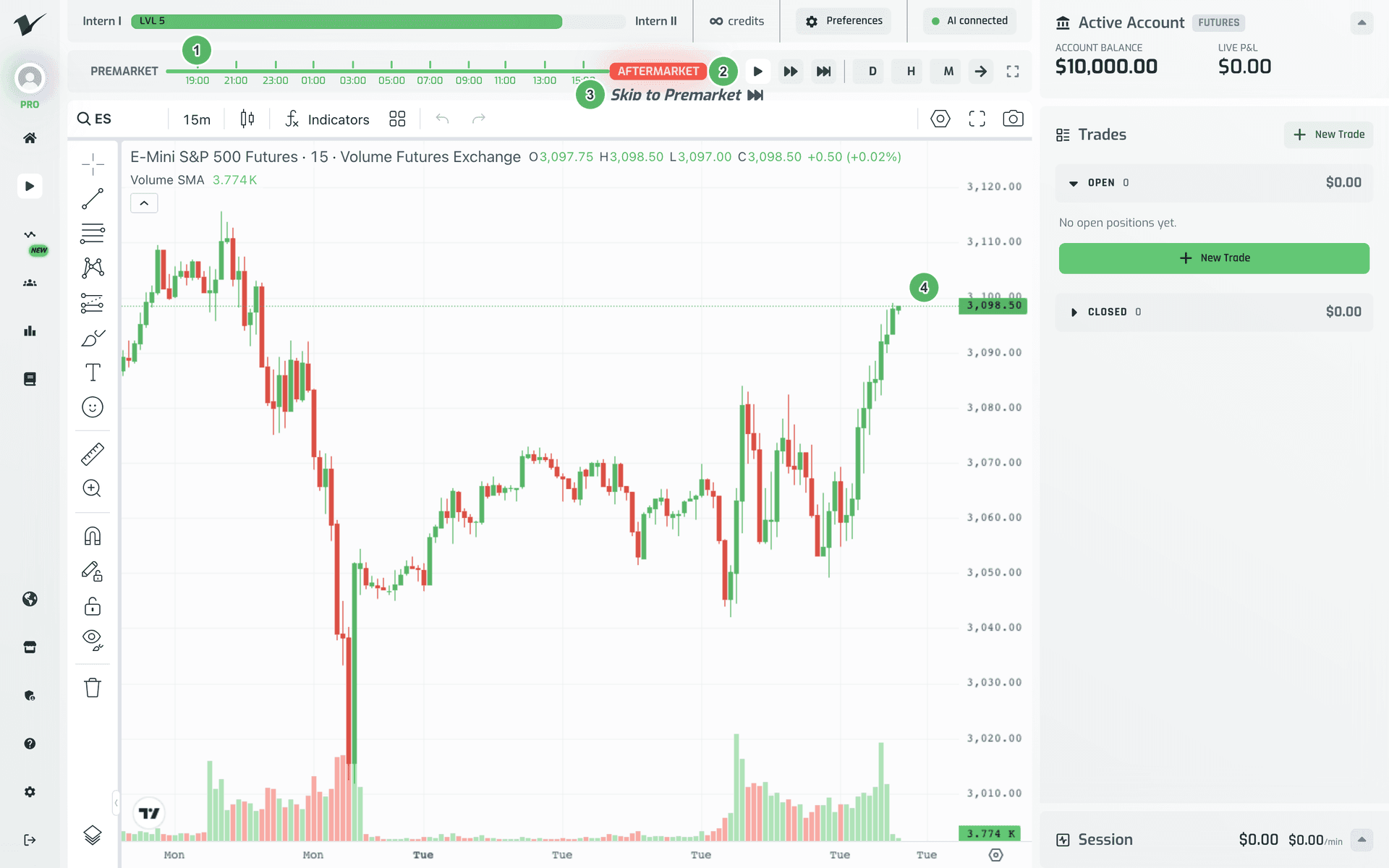
What you're seeing:
- The session timeline - A futures day in Volume starts at the 6:00 PM ET open (the first labeled tick, 19:00, is one hour in) and runs to the 5:00 PM ET close the next afternoon, the same session day the exchange uses.
- AFTERMARKET marker - Once the clock passes 5:00 PM ET, the current-time marker gives way to a red AFTERMARKET marker. The market is in its daily break, so prices stop updating.
- Skip to Premarket - Hover the marker to reveal the skip. Clicking it jumps the clock to the next real session (6:00 PM ET on a weekday, Sunday 6:00 PM ET over a weekend) instead of making you wait out the closed hour.
- Frozen chart - The last candle stays put because no real trades happened during the break, so there is no data to replay.
If the market closes in the middle of the session window you have configured (a holiday halt, for example), the timeline marker reads <time> · CLOSED instead, and clicking it skips to the next market open.
The trade ticket knows the market is closed
Open a new trade during a closed window and the ticket tells you right away.
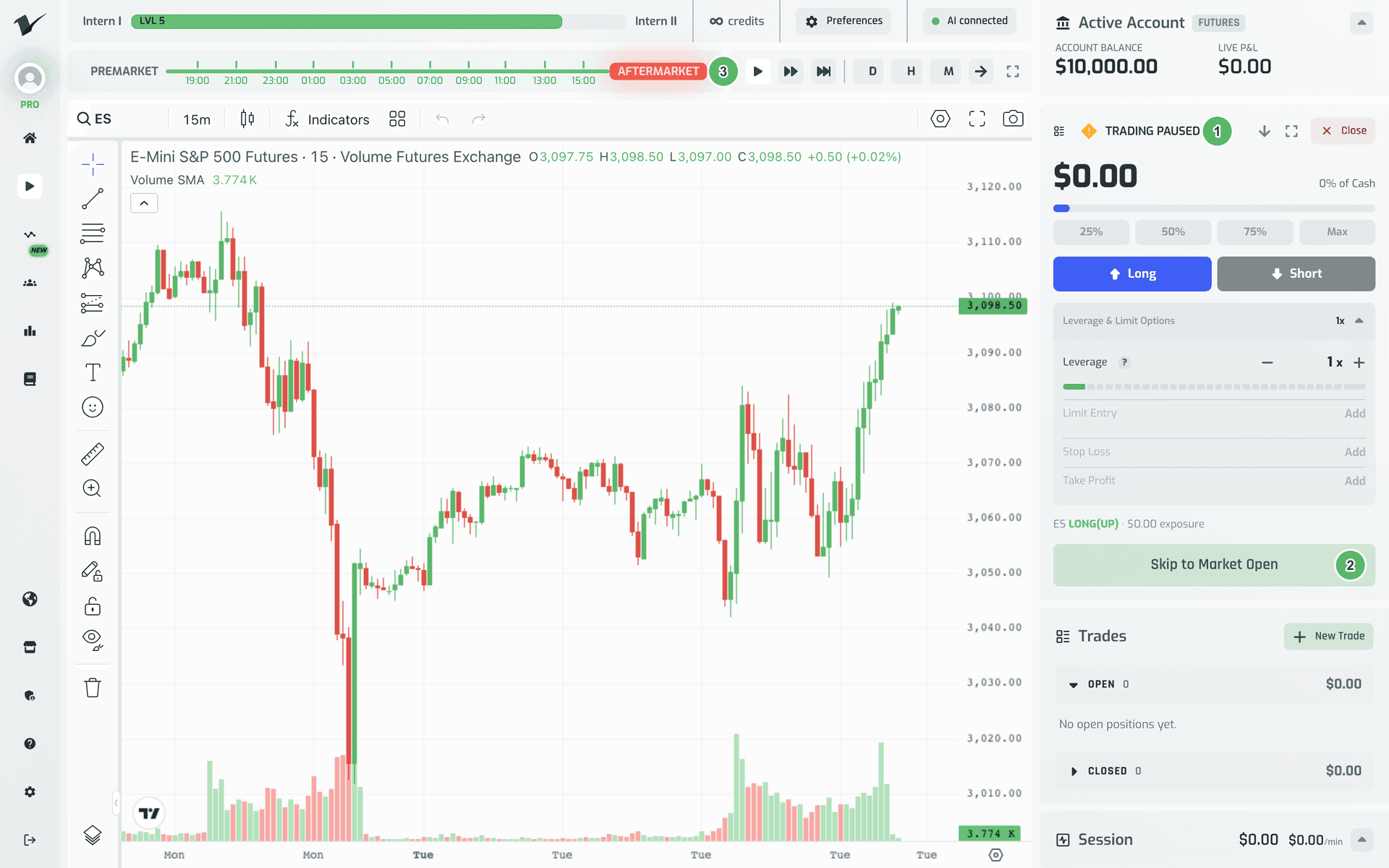
What you're seeing:
- TRADING PAUSED - The ticket header swaps the live price for a paused warning, so you know there is no market to trade against.
- Skip to Market Open - The confirm button is replaced by a skip. You can still set up your size, direction and stop loss, then jump straight to the open.
- AFTERMARKET marker - The same closed state shown on the timeline.
The rules are enforced on the server as well as on screen, so an order sent while the market is closed is rejected with a "Market is closed" message. Stocks follow the same pattern around their 9:30 AM and 4:00 PM ET boundaries (Volume only allows stock trades during regular hours, so use premarket to plan rather than trade), forex pauses from Friday 5:00 PM to Sunday 5:00 PM ET, and crypto games never close.
Times are shown in your local timezone
The rules above are defined in ET, but the gameroom displays every time on your own clock. If you are on the US West Coast, the futures daily break shows up as 2:00 PM to 3:00 PM, and the stock market opens at 6:30 AM. You never need to convert anything to read the timeline.
You can customize your session windows
Not everyone wants to sit through every hour. In Preferences → Timeline Configuration, you can set your own pre-market, open and after-market times, and choose which days are playable, separately for each market. Your skips then land exactly where you want to practice. The full walkthrough is in Customizing Market Hours in Volume. For more on how the replay itself works, see How Volume's Trading System Works.
FAQ
What time does the stock market open and close?
Regular US stock trading runs from 9:30 AM to 4:00 PM ET, Monday through Friday. Premarket trading starts at 4:00 AM ET, and after-hours trading runs until 8:00 PM ET. On half days, the regular session closes at 1:00 PM ET.
When does the futures market close?
CME equity index futures close for the weekend at 5:00 PM ET on Friday and reopen at 6:00 PM ET on Sunday. Monday through Thursday, they also pause for a daily maintenance break from 5:00 PM to 6:00 PM ET.
What are forex trading hours?
Forex trades continuously from Sunday 5:00 PM ET to Friday 5:00 PM ET. There is no daily close, and the market stays open on most US holidays. It is closed on Saturday, Christmas Day and New Year's Day.
Is the crypto market ever closed?
No. Crypto trades 24/7, including weekends and holidays. Liquidity changes throughout the day, but there is no scheduled close.
Why does the futures market have a daily break?
The one-hour break from 5:00 PM to 6:00 PM ET gives the exchange time for daily settlement and system maintenance between trading days. The session that opens at 6:00 PM belongs to the next trading day.
Do market hours change with daylight saving time?
Not in ET. US markets follow New York's clock, so the times stay the same all year in Eastern Time. If you live somewhere that changes clocks on different dates (for example, Europe), the gap between your time and ET can shift for a few weeks in March and in the fall.
Practice Across Every Session
Knowing the schedule is one thing. Getting a feel for how a market behaves around its open, its daily break and its weekly close takes repetition. Open the gameroom, pick a market, and watch a few sessions roll through on real historical data, with a virtual balance and nothing at stake but your own practice.